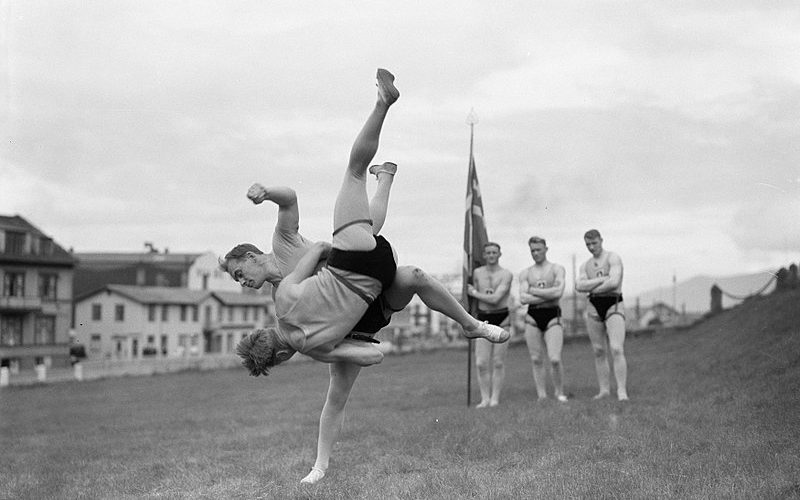
One of the last major landmasses to be settled by human beings, Iceland is nowadays a thriving modern nation that boasts a highly educated populace and one of the highest standards of living on Earth. The world of the earliest Icelandic settlers, however, was significantly different - one of endless, back-breaking agricultural work carried out amid brutal North Atlantic weather and the constant threat of violent family feuds. Their wrestling matches could often be similarly wild and injurious, often barely distinguishable in motivation or consequence from a duel fought with sword or axe.
As this young society began to mature and regulate itself, however, their wrestling began to change accordingly. And just like the modern nation of Iceland emerged out of a fractious mass of Nordic and Celtic settlers on the edge of the world, the Icelandic national wrestling style, Glima, gradually took form. A game of joy - of truly convivial wrestling - Glima is both stylistically unlike any other grappling tradition on Earth, and a physical manifestation of the discipline that Iceland forced on itself in order to balance the conflicts of an honour-driven society with the need for mutual cooperation in order to survive.
Also available on iTunes, Stitcher, and Spotify
Acknowledgements:
Thanks to Sigurður Óli Rúnarsson of Glímusamband Íslands for providing a crash course in Glíma and some invaluable insights into the modern Glíma scene, Brian Jones of Old School Jiu Jitsu for sharing his experience training in Glíma as a judo black belt, and Robin H. Denton of Nene Valley Judokai / Shudan Martial Arts for clarifying some judo concepts that were way out of my pay grade.
References:
- Ahola, Joonas. Outlawry in the Icelandic Family Sagas. PhD Thesis. University of Helsinki, 2014.
- Amory, Frederic. “Speech Acts and Violence in the Sagas.” Arkiv för Nordisk Filologi, vol. 106, 1991, pp. 57-84.
- Bjarnason, Jóhann Ingi. The History of Martial Arts in Iceland and Their Image in Media. B.A. Thesis. University of Akureyri, 2012.
- Boyce, John. “The Arctic Irish: Fact or Fiction?” History Ireland, vol. 18, no. 3, 2010, pp. 14–17. JSTOR, www.jstor.org/stable/40664789.
- Broz, Vlatko. “Kennings as Blends and Prisms”. Jezikoslovlje, vol.12, no. 2, 2011, pp. 165-186.
- Byock, Jesse. “Feuding in Viking Age Iceland’s Great Village.” Conflict in Medieval Europe: Changing Perspectives on Society and Culture. Eds. Brown, Warren C. & Górecki, Piotr. Routledge, 2003, pp. 229-241.
- Ciklamini, Marlene. “The Old Icelandic Duel.” Scandinavian Studies, vol. 35, no. 3, 1963, pp. 175–194. JSTOR, www.jstor.org/stable/40916463.
- De Boinod, Adam Jacot. “Cultural Vocabularies: How Many Words Do the Inuits Have for Snow?” The Guardian, 29 Apr. 2014, https://www.theguardian.com/education/2014/apr/29/what-vocabularies-tell-us-about-culture.
- Egeler, Matthias. “The Narrative Uses of Toponyms in Harðar Saga”. NORDEUROPAforum - Zeitschrift für Kulturstudien, pp. 80-101, 2018.
- Einarsson, Thorsteinn. Glima: The Icelandic Wrestling. Glímusamband Íslands, 1984.
- Etchingham, Colmán, et al. Norse-Gaelic Contacts in a Viking World: Studies in the Literature and History of Norway, Iceland, Ireland, and the Isle of Man. Brepols, 2019.
- Gunnell, Terry. “The Relationship between Icelandic ‘Knattleikur’ and Early Irish Hurling.” Béaloideas, vol. 80, 2012, pp. 52–69., www.jstor.org/stable/24862870.
- Guðmundsson, Böðvar & Pálsson, Heimir. Norrænir Guðir í Nýju Landi : Íslensk Heiðni og Goðsögur. Mál og menning, 2015.
- Gyönki, Viktória. The Representation of Outlaws in Post-Classical Icelandic Sagas: A Comparative Approach to Grettis Saga Ásmundarsonar and Króka-Refs Saga. MPhil Thesis. Universitetet i Olso, 2017.
- Harris, Richard L.. “The Deaths of Grettir and Grendel: A New Parallel”. Scripta Islandica, vol. 24, 1973, pp. 25-53.
- Hatton, Nathan. Thrashing Seasons: Sporting Culture in Manitoba and the Genesis of Prairie Wrestling. University of Manitoba Press, 2016.
- Hirsch, Bernard. “The Life of an Icelandic Outlaw: A Comparative Analysis of Gísla Saga and Grettis Saga”. Innervate, vol. 2, 2009 - 2010, pp. 193-199.
- Iþróttasamband Íslands. Glímubók. Prentsmiðjan Gutenberg, 1916.
- Josefsson, Johannes. Icelandic Wrestling. Pórh. Bjarnarson, 1908.
- Lawler, Andrew. “Kinder, Gentler Vikings? Not According To Their Slaves”. National Geographic, December 2015.
- Leonard, Stephen Pax. “Relative Linguistic Homogeneity in a New Society: The Case of Iceland.” Language in Society, vol. 40, no. 2, 2011, pp. 169–186. JSTOR, www.jstor.org/stable/23011806.
- Lindow, John. “Thor’s Duel with Hrungnir”. Alvíssmál, vol. 6, 1996, pp. 3-20.
- Mackintosh-Smith, Tim. Arabs: A 3,000-Year History of Peoples, Tribes, and Empires. Yale University Press, 2019.
- Magnússon, Sigurður Gylfi. Wasteland with Words: A Social History of Iceland. Reaktion Books, 2010.
- Miller, William I. “Of Outlaws, Christians, Horsemeat, and Writing: Uniform Laws and Saga Iceland.” Michigan Law Review, vol. 89, 1991, pp. 2081-2095.
- Ólafsson, Guðmundur, et al. “Surtshellir: A Fortified Outlaw Cave in West Iceland.” The Viking Age: Ireland and the West (Proceedings of the Fifteenth Viking Congress, Cork, 2005), Four Courts Press, 2005, pp. 283–297.
- Orchard, Andrew (Trans.). The Elder Edda: Myths, Gods, and Heroes from the Viking World (Legends from the Ancient North). Penguin Classics, 2013.
- Sayers, William. “Management of the Celtic Fact in Landnámabók.” Scandinavian Studies, vol. 66, no. 2, 1994, pp. 129–153. JSTOR, www.jstor.org/stable/40919640.
- Smiley, Jane (Ed.). The Sagas of Icelanders. Penguin Classics, 2001.
- Stapleton, Sarah, “Justice Done: Outlawry Crimes in Medieval Iceland”. Marshall Digital Scholar: Theses, Dissertations and Capstones, paper 967, 2015.
- Sveinsson, Einar Ól. “Celtic Elements in Icelandic Tradition.” Béaloideas, vol. 25, 1957, pp. 3–24. JSTOR, www.jstor.org/stable/20521244.
- Wetzler, Sixt. Combat in Saga Literature: Traces of Martial Arts in Medieval Iceland. PhD Thesis. Eberhard Karls Universität Tübingen, 2017.