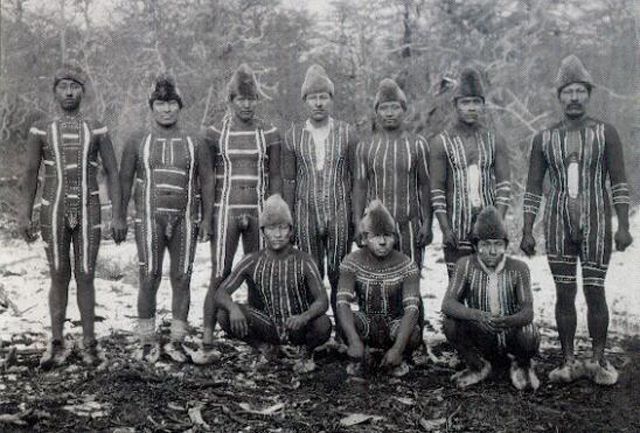
The Yaghan are - were - the southernmost people in the world; a scattered group of nomadic hunters living on the sub-antarctic inlets and islands of Tierra del Fuego. Yet despite being so isolated from the vast majority of the rest of humanity, and despite speaking a language entirely different from anything else on the planet, they got together and wrestled in a way that would be recognisable to any of us. How did they get there, how did they live, how did they wrestle, and where are they now? All that, and much more, we explore in this look at a culture that is in many ways unique but in other ways keenly familiar.
Also available on iTunes, Stitcher, and Spotify
References:
- Barclay, W. S. “The Land of Magellanes, with Some Account of the Ona and Other Indians.” The Geographical Journal, vol. 23, no. 1, 1904, pp. 62–79. JSTOR, www.jstor.org/stable/1775739.
- Blanchard, K. (1995). The Anthropology of Sport. Westport Conn.: Bergin & Garvey Publishers, 1995.
- Bridges, E. Lucas. Uttermost Part of the Earth: A History of Tierra Del Fuego and the Fuegians. Overlook/Rookery, 2007.
- Bridges, Thomas, et al. Yamana-English: A Dictionary of the Speech of Tierra Del Fuego. Zagier y Urrity Publicaciones, 1987.
- Calderon, Cristina. Hai Kur Mamashu Chis: I Want To Tell You a Story. CreateSpace Independent Publishing Platform, 2013.
- Chamberlain, Alexander F. “The Present State of Our Knowledge Concerning the Three Linguistic Stocks of the Region of Tierra Del Fuego, South America.” American Anthropologist, vol. 13, no. 1, 1911, pp. 89–98. JSTOR, www.jstor.org/stable/659811.
- Chapman, Anne. European Encounters with the Yamana People of Cape Horn, Before and After Darwin. Cambridge University Press, 2010.
- Chapman, Anne. End of a World: The Selk’nam of Tierra del Fuego. Zagier & Urruty Pubns, 2008.
- Chatwin, Bruce. In Patagonia. Picador, 1979.
- Cooper, John M.. Analytical and Critical Biography of the Tribes of Tierra del Fuego and Adjacent Territory. Government Printing Office, 1917.
- Furlong, Charles Wellington. “Some Effects of Environment on the Fuegian Tribes.” Geographical Review, vol. 3, no. 1, 1917, pp. 1–15. JSTOR, www.jstor.org/stable/207362.
- Hatton, Nathan. Thrashing Seasons: Sporting Culture in Manitoba and the Genesis of Prairie Wrestling. University of Manitoba Press, 2016.
- Kenny, Anna. “From Missionary to Frontier Scholar.” The Aranda’s Pepa: An Introduction to Carl Strehlow’s Masterpiece Die Aranda- Und Loritja-Stämme in Zentral-Australien (1907-1920), ANU Press, 2013, pp. 79–100. JSTOR, www.jstor.org/stable/j.ctt5hgz6k.12.
- “Language isolates.” Ethnologue. Web. 12 Dec 2018. .
- Leon-Portilla, Miguel. The Broken Spears: The Aztec Account of the Conquest of Mexico. Beacon Press, 2004.
- McWhorter, John. The Story of Human Language. The Teaching Company, 2004.
- Murphy, Dallas. Rounding the Horn: Being the Story of Williwaws and Windjammers, Drake, Darwin, Murdered Missionaries and Naked Natives - A Deck’s-Eye View of Cape Horn. Basic Books, 2005.
- Piana, Ernesto Luis, and Luis Abel Orquera. “The Southern Top of the World: The First Peopling of Patagonia and Tierra Del Fuego and the Cultural Endurance of the Fuegian Sea-Nomads.” Arctic Anthropology, vol. 46, no. 1/2, 2009, pp. 103–117. JSTOR, www.jstor.org/stable/40645466.
- Pigafetta, Antonio. The First Voyage Around the World by Magellan. London: Printed for the Hakluyt Society, 1874.
- Serrano Fillol, Albert. La Casa Stirling. Misiones Anglicanas Entre los Yaganes de Tierra del Fuego. Museo Antropológico Martín Gusinde, 2012.
- Smith, Larry Douglas. “Fitzroy and the Fuegians: A Clash of Cultures.” Anglican and Episcopal History, vol. 59, no. 3, 1990, pp. 386–403. JSTOR, www.jstor.org/stable/42610428.