The Caucasus mountains, a 750-mile-long chain of rock and ice stretching between the Black and Caspian seas, have traditionally been regarded as one of the great cultural boundaries between Europe and Asia. Nestled among its towering peaks and valleys are a tapestry of diverse peoples, many of whom speak languages unrelated to anything else on Earth. And stretching out on the southern side of these mountains lies Georgia - an ancient nation at the crossroads of East and West, with a history rooted in the earliest days of Christianity, in the movements of empires and armies, and in their ability to remain proudly distinct through it all.
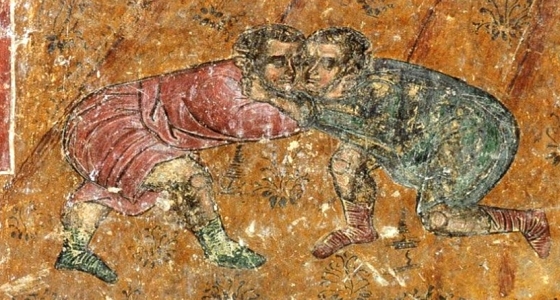
Visited by, traded with, and occasionally subjugated by the Greeks, the Romans, the Mongols, the Timurids, the Persians, and the Russians, modern Georgia is an independent, sovereign country that boasts several UNESCO-recognised cultural practices: an entirely unique writing system, a polyphonic musical tradition, a millennia-old method of wine-making, and a wrestling style whose name (“Chidaoba”) originally derived from a term meaning “a struggle between a man and a beast” but that ultimately came to embody the highest ideals of Georgian knighthood.
In this episode, we look at this land of highlanders, saints, and poets, the role that Chidaoba plays in their conceptions of “Georgian-ness”, and how the widespread practice of this hallowed wrestling style has elevated their small nation to the status of a world superpower in grappling sports like sambo and judo.
Also available on iTunes, Stitcher, and Spotify
References:
- Armstrong, Walter. Wrestling. Frederick A. Stokes Company, 1890.
- “Баши ачук”. YouTube, 27 Dec. 2011, https://www.youtube.com/watch?v=nMyVCL2Hl50&feature=youtu.be&t=1664. [in Russian]
- Catford, J. C. “Mountain of Tongues: The Languages of the Caucasus.” Annual Review of Anthropology, vol. 6, 1977, pp. 283–314. JSTOR, www.jstor.org/stable/2949334.
- “Chakrulo By Chveneburebi - Night Song Festival, Tallinn, Estonia, August 2008 - During the War”. YouTube, Aug. 2008, https://www.youtube.com/watch?v=tDdWFewtfzY.
- “Chidaoba, Wrestling in Georgia.” UNESCO, https://ich.unesco.org/en/RL/chidaoba-wrestling-in-georgia-01371.
- Chikvania, Tamaz. “Like a Bull, the Mingrelian was Driven Out to Meet the Lion, Gldaneli”. Sputnik Georgia, December 2015, https://sputnik-georgia.com/columnists/20151219/229526807.html. [in Georgian]
- Comrie, Bernard. “Linguistic Diversity in the Caucasus.” Annual Review of Anthropology, vol. 37, 2008, pp. 131–143. JSTOR, www.jstor.org/stable/20622617.
- Eichberg, Henning. Body Cultures: Essays on Sport, Space, and Identity. Routledge, 1998.
- Gabrichidze, Manana. “The Untold Story of How ‘Chakrulo’ Ended Up in Space”. Georgian Journal, 25 September 2014, https://www.georgianjournal.ge/discover-georgia/28321-the-untold-story-of-how-chakrulo-ended-up-in-space.html.
- “Georgians are warming up for Palavnoba championships”. Judo Inside, 7 December 2017, https://www.judoinside.com/news/2453/Georgians_are_warming_up_for_Palavnoba_championships.
- Ghambashidze, Nino & Makharadze, Nino. “St. George in Georgian Mythology and Folk Music”. The Feast of Saint George: Different Cultural Contexts and Traditions. Serbian Anthropological and Ethnological Society, pp. 9-27, 2018.
- Gippert, Jost. TITUS Didactica: Language Map Caucasus: Map Frame, http://titus.uni-frankfurt.de/didact/karten/kauk/kaukasm.htm.
- “Interview with Vladislav Koulikov on The Georgian Grip”. YouTube, 20 Nov. 2011, https://www.youtube.com/watch?v=ZX5qzFbYCc4.
- Jordania, Joseph. “A New Interdisciplinary Approach to the Study of the Origins of Traditional Polyphony”. Musicology, vol. 18, 2015, pp. 77-98.
- Kennan, George. Vagabond Life: The Caucasus Journals of George Kennan. University of Washington Press; Reprint edition, 2015.
- Kinzer, Stephen. “Saguramo Journal; On the Tallest Pedestal, a Man for All Georgians.” The New York Times, 7 May 1998.
- Layton, Susan. “Eros and Empire in Russian Literature about Georgia.” Slavic Review, vol. 51, no. 2, 1992, pp. 195-213. JSTOR, www.jstor.org/stable/2499527.
- Maghradze, David et al. Grape and Wine Culture in Georgia, the South Caucasus. 39th World Congress of Vine and Wine, 2016.
- Mandziak, Alexey & Artemenko, Oleg. The World Encyclopedia of Wrestling. Self-published, 2010. [in Russian]
- Manning, H. Paul. “Describing Dialect and Defining Civilization in an Early Georgian Nationalist Manifesto: Ilia Ch’avch’avadze’s ‘Letters of a Traveller”. The Russian Review, vol. 63, 2004, pp. 26-47.
- Nasmyth, Peter. Georgia: In the Mountains of Poetry. Curzon Press, 1998.
- Ninoshvili, Lauren. “The Poetics of Pop Polyphony: Translating Georgian Song for the World”. Popular Music and Society, vol. 32, July 2009, pp. 407-424.
- Petrov, Rayko. The Roots of Wrestling: The Traditional Styles. Fédération Internationale de Lutte Amateur, 2000.
- Petrov, Rayko & Bakalova, Sylvia. Wrestling in the Written Word. Balkan Publishing Company, 2011.
- Pickering, Mark. “The Man Behind the Khabareli”. International Judo Federation, March 2019, https://www.ijf.org/news/show/Khabareli.
- Polet, Jean-Claude. Patrimoine littéraire européen, vol. 4a, Le Moyen Âge, de l’Oural à l’Atlantique. Littératures d’Europe orientale, De Boeck, 1993. [in French]
- Rustaveli, Shota. The Knight in the Panther’s Skin. Sabchota Sakartvelo, 1986.
- Scott, James C.. The Art of Not Being Governed: An Anarchist History of Upland Southeast Asia. Yale University Press, 2011.
- Sebag Montefiore, Simon. Young Stalin. Orion Publishing, 2008.
- “Оn the Development of Freestyle Wrestling”. Order of the All-Union Council on Physical Culture and Sports of the USSR, November 1938, http://www.sambo.spb.ru/history/633/633_1938_11_16.htm. [in Russian]
- “The Georgian Grip with Vladislav Koulikov - Preview”. YouTube, 20 Nov. 2011, https://www.youtube.com/watch?v=opDvdGxqijQ.
- Tsereteli, Akaki. Bashi Achuki. The National Parliamentary Library of Georgia, 1895, http://www.nplg.gov.ge/ebooks/authors/akaki_cereteli/motxrobebi/bashi-achuki.pdf. [in Georgian]
- Tsitsishvili, Nino. “A Historical Examination of the Links Between Georgian Polyphony and Central Asian-Transcaucasian Monophony.” Echoes from Georgia: Seventeen Arguments on Georgian Polyphony, edited by Rusudan Tsurtsumia and Joseph Jordania, Nova Science Publishers, 2010, pp. 195–214.
- Uchidze, Tamuna. “Aspindza celebrates its 52nd ‘Shotoba’”. SK News Georgia, September 2018, http://sknews.ge/index.php?newsid=19461. [in Georgian]
- Volkov, Vladimir. Course in Self-Defence Without Weapons (Sambo). Publication of the School and Course Department of the NKVD of the USSR, 1940.
- “World Ranking List.” International Judo Federation, https://www.ijf.org/wrl. [Accessed 23 Sep. 2019]
- Zeman, G. “The Napoleon, Model 1857, Light 12 Pounder Gun-Howitzer”. National Park Service, 2001, http://www.nps.gov/archive/vick/interp/napoleon.htm.
- Zhemukhov, Sufian & King, Charles. “Dancing the Nation in the North Caucasus.” Slavic Review, vol. 72, no. 2, 2013, pp. 287–305. JSTOR, www.jstor.org/stable/10.5612/slavicreview.72.2.0287.